


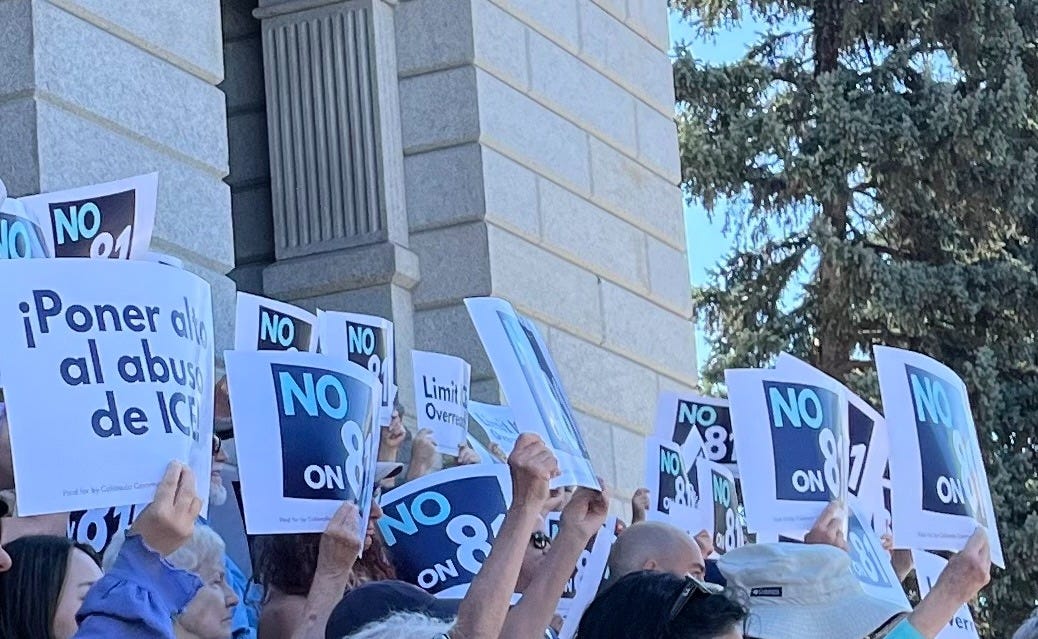
Colorado voters will decide this election season whether to force local law enforcement to help federal immigration officials, as the Trump administration continues its unpopular mass deportation efforts.
The ballot measure, known as Amendment 81, would change Colorado’s constitution to require law enforcement to determine the immigration status of anyone charged with a violent crime and anyone charged with any crime if they were previously convicted of a felony.
If local cops can’t confirm that the person charged has lawful immigration status, they would have to report them to the U.S. Department of Homeland Security, the parent agency of Immigration and Customs Enforcement (ICE).
Amendment 81 is backed by conservative activist networks that are behind a majority of this year’s ballot measures.
The backers have mounted virtually no public campaign to promote the measure, but Republican candidates and supporters are promoting it in their voting guides, according to Christina Adams, the president of the Eagle County Republican Women Club, which is one of the measure’s registered supporters.
“It’s because of all the people that have been murdered by illegal aliens,” Adams told The Blanket. “People want to be safe and secure.”
When pushed for specifics on the connection between crime and immigration, Adams tried and failed to look up supporting statistics while on the phone with The Blanket. She then recounted an anecdote of an assault she said one of her friends experienced before abruptly ending the call.
Research has consistently found that unauthorized immigrants do not increase crime rates.
An opposition campaign that launched last week has countered that Amendment 81 could harm rather than help public safety efforts.
“We’ve seen aggressive enforcement actions here in Colorado that impact everyone,” said Henry Sandman, the co-executive director of the Colorado Immigrant Rights Coalition, the main organization behind the opposition campaign along with the ACLU of Colorado.
Community concerns
Colorado appears to have little appetite for increased cooperation with ICE.
Two-thirds of Coloradans polled in March said that they worry ICE might be detaining the wrong people. That fits into a broader national sentiment of disagreement with the Trump administration’s deportation drive and distrust toward the federal immigration agency whose officers have killed several U.S. citizens this year.
Current law allows – but does not require – Colorado law enforcement to cooperate with ICE in criminal cases, though it restricts cooperation on civil immigration enforcement.
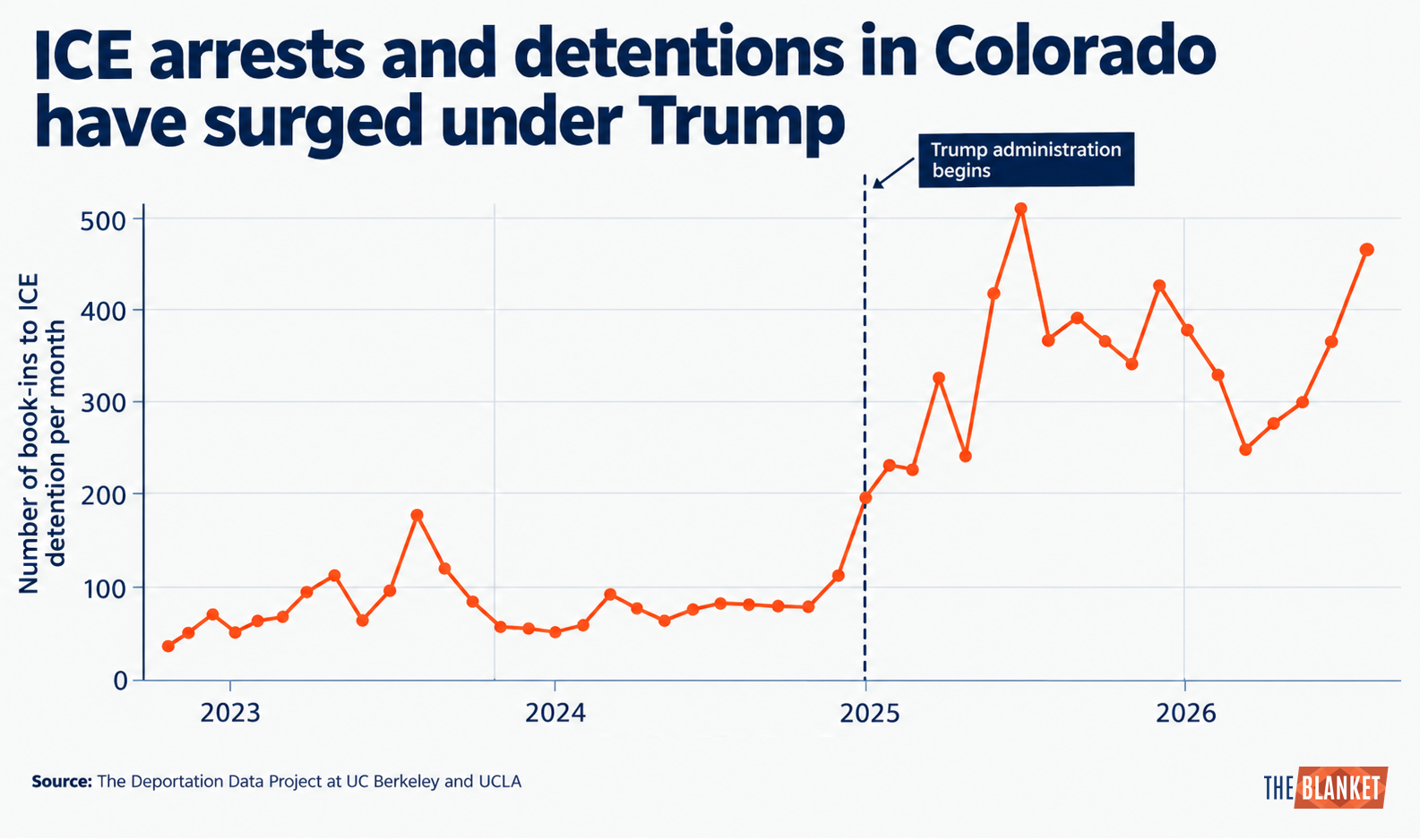
While some Colorado law enforcement agencies choose to cooperate with ICE, some have tried to distance themselves from the federal agency.
Denver Police Chief Ron Thomas said earlier this year that his officers would intervene if they saw ICE agents using excessive force. Gunnison County Sheriff Adam Murdie said last month that he would stop working with ICE after hearing concerns from community members.
Forcing law enforcement to work with ICE could degrade trust between communities and local authorities, Larimer and Jackson county District Attorney Gordon McLaughlin said at the opposition campaign launch last week.
“If victims in the community do not trust that we are fighting for them, they do not pick up the phone, they do not make that call, they do not come into court, they do not report their abuser. That means that law enforcement cannot do our jobs to support victims and keep our community safe,” McLaughlin said.
The statewide associations representing sheriffs and district attorneys have not taken an official position on the measure.
Cost concerns
Opponents of Amendment 81 also say it could increase costs for taxpayers.
Neither the opposition campaign nor analysts who work for the state government cite specific estimates, but both agree that local law enforcement would need additional resources to comply with the requirement to determine the immigration status of the criminal suspects covered by the amendment.
“I can’t imagine that this would not be a huge impact on municipalities,” said Ariane Frosh, policy counsel at the ACLU of Colorado.
Trump’s immigration agenda is already costing Colorado taxpayers thousands of dollars each due to a massive federal funding increase over the past two years, according to an estimate from the progressive Economic Policy Institute think tank.
But the benefits of that spending are far from clear.
Colorado’s relatively high violent crime rates declined last year, following long-term national trends. But only a small share of people recently arrested by immigration authorities have had violent criminal records, making it unlikely that ramped-up ICE activity under Trump contributed to the decrease.
The federal immigration enforcement drive is also disrupting labor supplies in some industries and removing economically productive immigrants from the country – undermining the administration’s arguments that deportations will help the economy.

NEED TO KNOW
⚕️ The rising cost of Medicaid is crowding out other public programs in Colorado’s state budget, meaning more cuts to healthcare aid are likely coming. Medicaid spent $158 million more than it budgeted for last year, and projections show that figure could increase to $443 million this year. (CPR News / John Daley, 9News / Marshall Zellinger, read our explainer on how the state budget works)
💸 Backers of two anti-trans ballot measures paid to gather signatures to get their measures on the ballot, but didn’t report those payments to state election authorities as the law requires, according to a complaint filed by opponents of the measures. (Colorado Times Recorder / Jamie O’Rourke, read our coverage of the ballot measures)
🧐 Supporters of a ballot measure to implement a graduated income tax in Colorado used paid signature gatherers who weren’t properly registered to get their measure on the ballot, according to a lawsuit filed by opponents. (The Sum & Substance / Ed Sealover)
🔥 Wildfire prevention and mitigation efforts could combine multiple strategies to improve their effectiveness, according to two Colorado-based researchers. Experts sometimes disagree over whether the “best” approach is to quickly suppress fires when they break out, prevent fires by clearing fuel, or manage fires to control how they burn. But the researchers say the various camps should work together to design more holistic strategies. (The Conversation / Tony Cheng and Matt Thompson)
⚖️ Colorado’s state Supreme Court is pausing mandatory livestreaming of criminal proceedings for 90 days while it seeks solutions for repeated intentional disruptions and misuse of the videos. State law dating back to 2023 requires courts to livestream criminal proceedings. But Chief Justice Monica Márquez said that the streams have been illegally recorded and posted on social media, and that viewers have harassed court participants, undermining the integrity of the judicial process. (Denver Post / Shelly Bradbury, read the Supreme Court directive)
🖊️ The Colorado secretary of state’s office is taking action on fraudulent business registrations under a law that went into effect in August. Officials marked nearly 13,000 entities as fraudulent and deleted more than 10,000 others over the last month, using expanded powers in the new law to target fraud networks using fake companies to cover their tracks. (Denver Gazette / Mark Samuelson, read the secretary of state’s press release)
FOLLOWING UP
🔍 I mentioned last week that I’d be doing more “ask me anything” videos. Here’s the latest installment. I’ve been getting a lot of questions about “bias” in my reporting, so I decided to lay out what I think about it. Let me know your thoughts!