


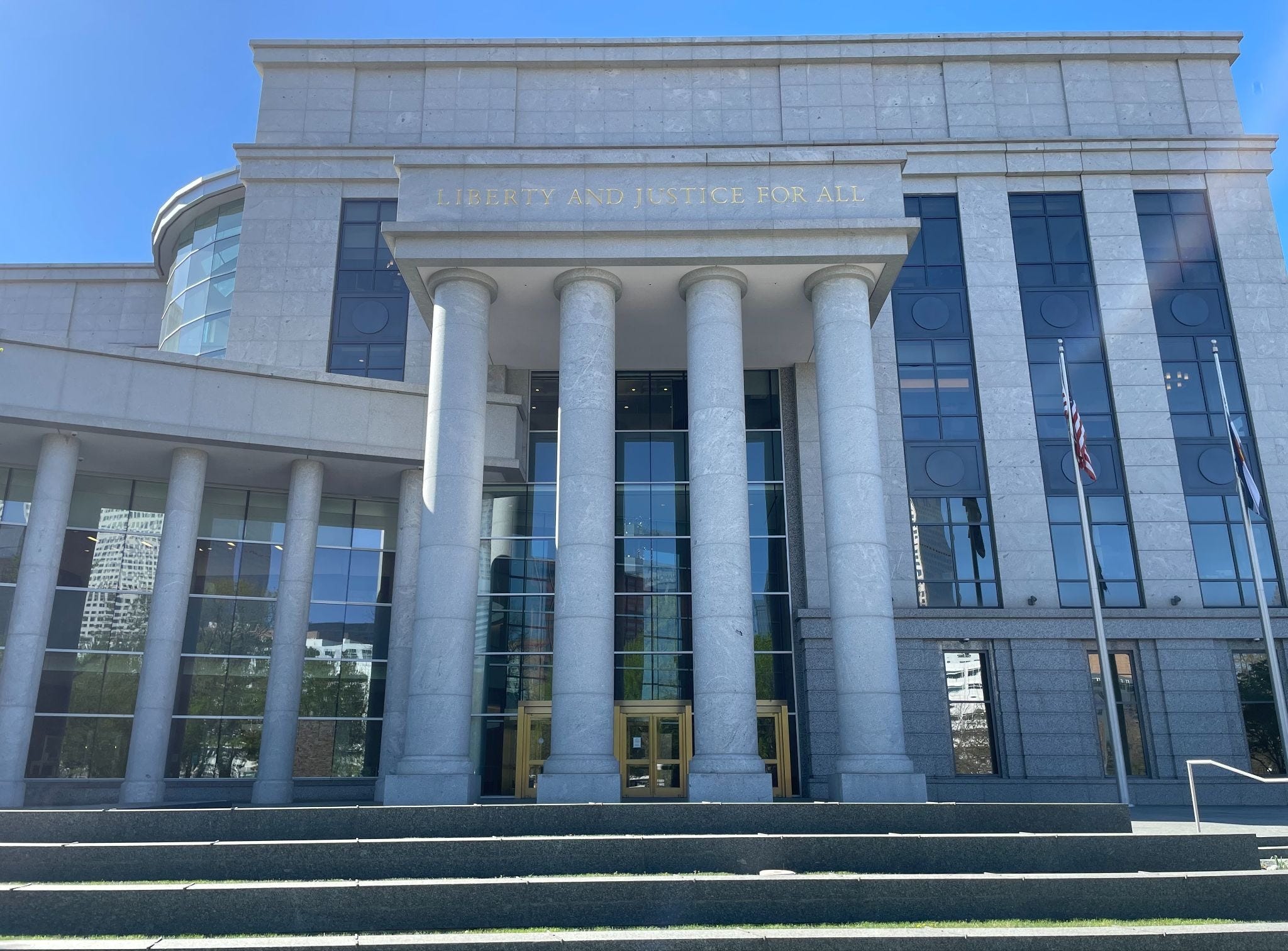
Colorado has become a key battleground in legal fights over the role of state and local authorities with respect to federal immigration enforcement.
Courts in Colorado are weighing whether state and local regulations apply to immigration detention centers, when state and local officials can refuse to cooperate with federal immigration agents, and whether undocumented students can get tuition benefits at Colorado universities.
Similar questions are also coming up in other states, as the Trump administration continues an aggressive anti-immigration crackdown that has communities across the country looking for ways to minimize the human and economic fallout.
To get a clearer picture of the legal issues at play, I talked with Deep Gulasekaram, a professor at the University of Colorado Boulder who specializes in immigration law and constitutional law.
“If there’s anything to say in broad terms it is that this area of law is highly unsettled, that there are lots of unanswered questions which are being asked and answered right now,” Gulasekaram said.
Read on for highlights of the conversation, and watch the extended interview below 👇
Detention centers
One question that has become more prominent and more urgent in recent weeks is whether state and local authorities can apply health and safety regulations to immigration detention facilities.
In mid-July, the Adams County Health Department confirmed a case of tuberculosis at Colorado’s only large-scale immigration detention center – a facility in Aurora that houses about 1,200 people.
But local officials say they’ve been blocked from investigating further by the GEO Group, the private contractor that runs the facility for the federal immigration agency ICE. GEO recently announced a new contract with ICE to reopen a former prison in Hudson as Colorado’s second 1,200-bed immigration detention center.
ICE told me that while there aren’t any confirmed tuberculosis cases at the Aurora facility right now, “there was one case of TB on June 25, and the detainee was treated, cleared, and removed from the country.”
GEO sued Colorado in federal court earlier this year over a new state law aimed at expanding local authorities’ power to do health and safety inspections at immigration jails. The company argued that the regulations would illegally interfere with the federal government’s authority to enforce immigration laws.
ICE is changing its internal rules to try to give contractors legal protection against local and state regulations, according to recent reports from the Washington Post and WIRED.
The plans for the new facility in Hudson sparked a separate fight in state court, where a legal advocacy group is backing a Hudson resident’s lawsuit aiming to make the town enforce local zoning requirements on the proposed facility.
Although the GEO Group and Hudson lawsuits involve different legal specifics, they address similar legal issues around the authority of state and local governments to impose regulations on the federal government or its contractors.
“This has been a question that has been a part of American constitutional law going back centuries,” Gulasekaram said.
Information sharing
Legal controversy has also unfolded around state laws passed in recent years that bar Colorado officials from giving people’s personal information to ICE unless it’s part of a criminal investigation.
A federal judge recently tossed a lawsuit involving the Mesa County Sheriff’s Office, which had argued the laws are too vague and create confusion around the limits of cooperation with immigration authorities.
A separate lawsuit in state court is looking at the same law from a different angle. Gov. Jared Polis has been fighting to force the state’s Department of Labor to respond to a request for information from ICE. A judge ruled the Department of Labor doesn’t have to comply, saying the information requested is not related to a criminal matter. Polis appealed that ruling, but the parties recently asked to pause the case until a new governor takes office next year.
Other states have similar laws restricting information-sharing and cooperation with ICE, often with exceptions for criminal investigations. But leveraging information compiled by local authorities makes ICE’s job a lot easier, so the agency has an incentive to try to make the most of those exceptions.
“That leaves the factual question whether in fact the information being sought was in connection with some very serious allegation and of criminality, or whether it looks very much like a fishing expedition,” Gulasekaram said.
Tuition and financial aid
The latest challenge to Colorado’s immigration policies is the federal government’s lawsuit over a program that offers in-state tuition and aid to undocumented university students who meet certain residency requirements.
More than a dozen other states have faced similar lawsuits claiming the policies violate federal law because they don’t offer the same benefits to out-of-state U.S. citizens.
Courts have ruled both for and against states that offer in-state tuition to undocumented students, but Gulasekaram said recipients may still face barriers related to their lack of lawful status after they graduate.
“Ultimately whether you can use your degree to work for the benefit of the people of the state of Colorado or the people of the United States – that is controlled in large part by federal law,” he said.

NEED TO KNOW
🏘️ Cutting red tape has helped lower the cost of building affordable housing in Colorado compared to states like Texas and California. Recent measures made it easier to use publicly owned land for affordable housing development, simplified paperwork and changed building and inspection rules to accommodate low-cost construction options. A recent poll found housing affordability and other cost-of-living issues are among Coloradans’ top concerns. (The Conversation / Solomon Greene, read the poll)
📚 Colorado education officials allowed hundreds of thousands of dollars of public funding to flow to a school with Christian religious curriculum. The Colorado Department of Education said it doesn’t have the authority to enforce state and federal constitutional restrictions against government support for religious institutions, claiming that is the role of the courts, but an independent legal expert questioned that assertion. The “public Christian school” closed this year after lawmakers passed new rules unrelated to religious affiliation. (Chalkbeat / Ann Schimke, May 29 newsletter)
🏫 A top federal civil rights official, Harmeet Dhillon, publicly expressed support for parents whose complaint led to an investigation of Jeffco Schools’ transgender policies. Dhillon runs the U.S. Department of Justice Civil Rights Division, which is in charge of deciding whether to cut off federal money to Jeffco, the state’s second-largest district, over its policies aimed at protecting transgender kids. Jeffco sued the U.S. Department of Education this week over the threats to cut its federal funding. (Class Notes / Suzie Glassman, Chalkbeat / Erica Meltzer, July 3 newsletter, read the new lawsuit)
⏳ The Colorado Bureau of Investigation has reduced the average processing time for rape kits to about six months, down from more than 500 days last year. That’s still short of a 90-day internal goal and a 60-day target set by state law, and victim advocates say the backlog is hindering justice. The backlog resulted from staff shortages after crime lab workers were tasked with reviewing over 1,000 cases handled by Missy Woods, a former forensic scientist who admitted this year to manipulating test results over the course of nearly three decades at the agency. (Westword / Hannah Metzger, June 26 newsletter)
🚱 Wildfire response and recovery could cost Colorado nearly a quarter of a billion dollars, according to an estimate from the state’s official Drought Task Force. A historically hot and dry winter in Colorado raised wildfire risk and added urgency to water-saving measures. The task force also recommended improving water efficiency at state facilities and temporarily extending tax deadlines for drought-impacted small businesses and agricultural producers. (CPR / Tegan Wendland, Colorado Sun / Shannon Mullane, CBS / Christa Swanson, watch the full meeting)
COMING UP
🧗 I’ve been lining up more interviews with people working directly on solutions and accountability here in Colorado, and I’m also chipping away at a few original reporting projects. I don’t want to give too much away or make any promises I can’t keep, so suffice it to say that I’m excited and hopeful you’ll find value in what I’m preparing. Speaking of which, if you find value in this newsletter, please consider sending it to a friend or contributing financial support. Anything helps.