



This exclusive investigative reporting is made possible by your support. Please consider a subscription or one-time financial contribution to help us keep bringing you independent solutions and accountability news.
Colorado has updated its official data on complaints against insurance companies, correcting errors and adding missing information identified by The Blanket.
The state’s insurance regulator, the Division of Insurance of the Department of Regulatory Agencies, told The Blanket this week that it has fixed flaws in a public database containing statistics on complaints against health, auto, home and life insurance companies.
“Since you brought this to our attention, we took a look at the data comprehensively to make sure it was accurate,” the agency’s communications director Genna Morton said. “We recognize that some of the data had glitches and inaccuracies in it and we made efforts to correct it.”
The database lists annual statistics stretching back to 2006, showing how many complaints were made about each company in each sector and assigning each company an index score that shows how it compares to its competitors.
But the database has demonstrated shortcomings in terms of timeliness and reliability.
In April, The Blanket notified the Division of Insurance that data from 2020 had never been uploaded and that data from 2024 contained errors that affected the calculations of the index scores. In July, the agency updated the database to correct the 2024 data and add data from 2020 as well as 2025.
However, when the agency was notified that the 2025 data also contained errors, officials decided to go back and verify data from all previous years.
As of August 18, Morton said the agency is “not aware of any further issues at this time.”
What the data shows
The newly validated database provides information that could help consumers when shopping for insurance.
One of those data points is an index score that shows how companies compare with their competitors. An index score over 1 means a company got more complaints than average for a company its size.
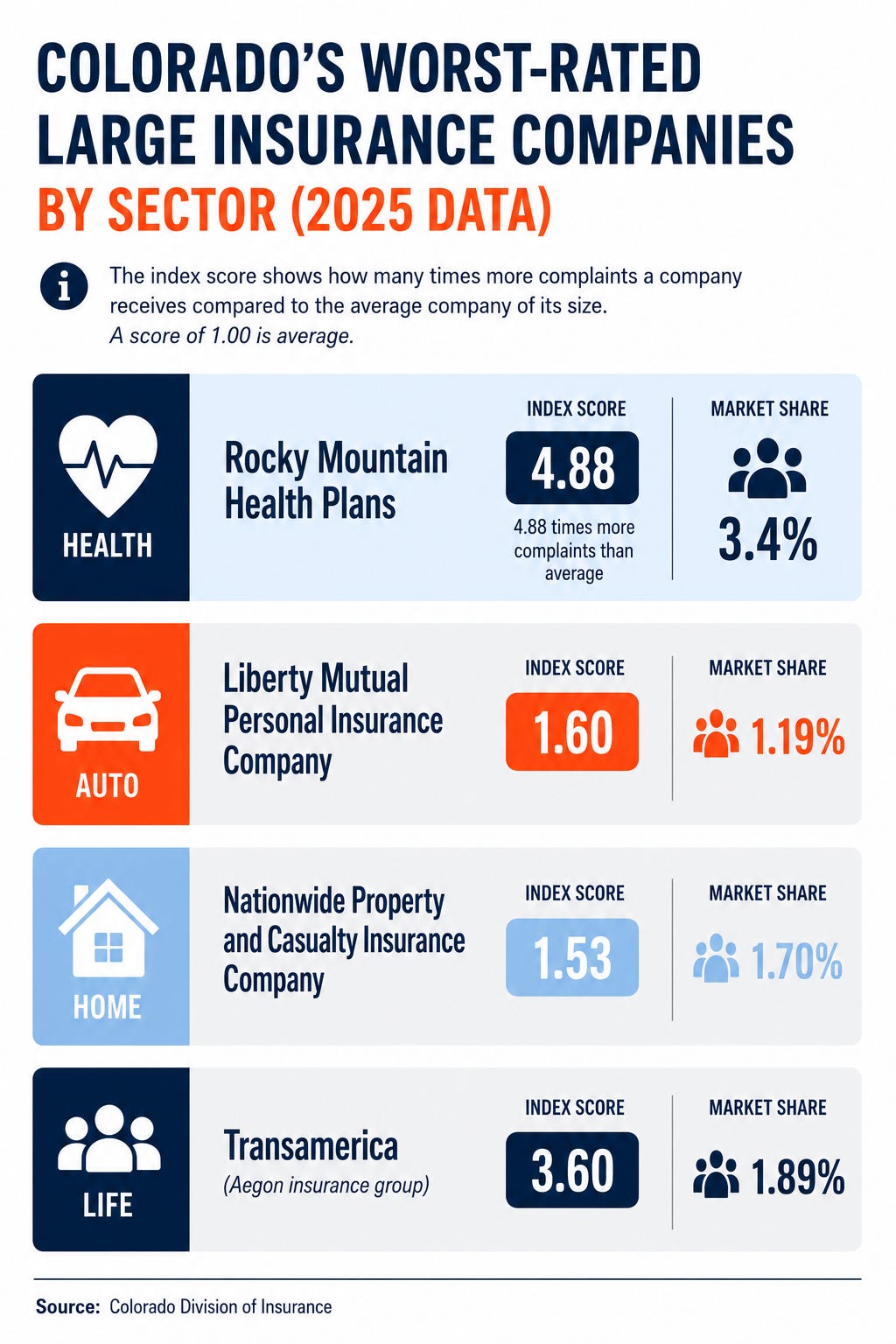
For example, Rocky Mountain Health Plans, the worst-rated health insurer with more than 1% market share, had an index score of 4.88, meaning it got 4.88 times more complaints than average for a company its size. The company, a subsidiary of UnitedHealthcare, has a 3.4% market share.
In the auto sector, the worst-rated large insurer was Liberty Mutual Personal Insurance Company with a score of 1.6 and a market share of 1.19%. Another Liberty subsidiary, LM General Insurance Company, had a score of 1.01 and a 0.3% market share.
The worst-rated large home insurer was Nationwide Property and Casualty Insurance Company with a score of 1.53 and a 1.7% market share. Nationwide Insurance Company of America, another company belonging to the same insurance group, had a score of 1.84 and a market share of 0.46%.
The worst-rated large life insurer was Transamerica, belonging to the Aegon insurance group, with a score of 3.6 and a market share of 1.89%.
None of those companies responded to requests for comment. Insurance industry trade groups including the Rocky Mountain Insurance Association, the Colorado Association of Health Plans and the American Property Casualty Insurance Association also did not respond to requests for comment.
The Division of Insurance doesn’t appear to subject companies with worse scores to increased scrutiny. When asked about this, Morton, the agency spokesperson, responded that the purpose of the database is “to allow consumers to compare insurance carriers.”
A high index score could be a red flag for consumers when considering a particular company.
“Usually when somebody’s going out of the way to complain, it means they’ve had a pretty big problem,” said consumer advocate Danny Katz, the executive director of the Colorado Public Interest Research Group.
But the company with the lowest complaint score may not always be the best choice. Consumers should shop first by looking for companies that offer coverage that fits their specific needs, Katz recommended.
“Start by just being very clear on what you want,” Katz said. “You may use this [complaint data] later in the process when you start to circle around a couple of options.”
Watch the full conversation with Katz 👇
Limitations of the data
Beyond the errors identified by The Blanket, the database has additional shortcomings.
For one, the Division of Insurance doesn’t track the percentage of complaints that result in a favorable resolution for the consumer.
The database tracks only a single statistic of “confirmed complaints,” which includes complaints that result in a favorable resolution as well as complaints where the company is found to be at fault, even if the consumer doesn’t get a favorable resolution.
The agency publishes annual reports that provide summaries of its work investigating and addressing the thousands of complaints and questions it receives each year.
The agency says it has recovered more than $85 million for consumers since 2021. It also fields many consumer inquiries that resolve issues short of filing a complaint, and it offers consumer education resources.
Still, more data about how complaints are resolved could provide a clearer view of the agency’s effectiveness and companies’ responsiveness.
The database also doesn’t contain any information about the reasons for the complaints, so it’s not possible to determine how many were related to wrongful coverage denials, delayed or incorrect payments, or other allegedly improper business practices.
“Every detail will give us a little bit more information as a consumer to be able to make smart decisions and as a regulator to be able to identify, is there a consistent problem with a specific company,” Katz said.
How to improve the database
Even though Colorado’s insurance complaint database could be useful to consumers, few know about it.
The Division of Insurance typically doesn’t announce publicly when it posts new data, and it doesn’t actively promote the database beyond simply publishing it on its website.
“We are always happy for the support of journalists to help us promote this kind of data and information for consumers,” Morton, the agency spokesperson, said.
The Blanket was not able to find any other news reports mentioning the database.
In addition to raising awareness, another way to make Colorado’s database more useful would be to improve the user interface.
Currently, the data is only accessible in individual spreadsheets – one dataset per sector, per year. To see trend lines of how companies’ complaint scores change over time, the spreadsheets must be downloaded separately and manually combined into a new dataset for analysis and visualization.
“This would be an easy thing for the state to do,” Katz said.
The federal Consumer Financial Protection Bureau has maintained a public database of complaints against financial companies with data visualizations and narrative details about individual complaints, which keep the complainants anonymous. Katz pointed to it as a model that Colorado could follow.
But after Katz spoke with The Blanket, the CFPB announced last week that it will stop publishing the visualizations and narratives, calling them “misleading” and saying their publication “needlessly harms companies’ reputations.”

NEED TO KNOW
👀 New evidence suggests the Trump administration weaponized federal aid to put pressure on Colorado to release election denier Tina Peters from prison. Lawyers for the state say an internal White House email proves the administration coordinated efforts to freeze hundreds of millions of dollars in federal aid to Colorado over Peters’ case and Colorado’s election management more generally. Governor Jared Polis granted Peters clemency earlier this year, but he has consistently denied that pressure from the Trump administration had anything to do with his decision. (Denver Post / Seth Klamann, Denver Post / Seth Klamann)
🧑⚖️ Colorado can’t enforce part of law that targeted private immigration detention facilities with extra health and safety requirements, a federal judge ruled this week. The judge agreed with ICE contractor The GEO Group that the law improperly singles out immigration detention facilities. The judge left some parts of the law intact, but largely because they hadn’t actually come into force yet. And he said the block is only in place until GEO’s current contract with ICE runs out in October. A new contract could “alter the analysis significantly,” the judge said. (read the order)
⚕️ Colorado is suing The GEO Group to get information about an alleged tuberculosis outbreak at the Aurora immigration detention facility. The Colorado Department of Public Health and Environment had ordered GEO to provide information by this week, but the company failed to comply. GEO had also rejected a similar, previous order from Adams County officials. U.S. Sen. John Hickenlooper visited the facility this week and told reporters that GEO employees had been instructed not to provide any information due to ongoing legal fights over the power of state and local officials to regulate federal immigration detention facilities operated by private companies. (Colorado Attorney General’s Office, Colorado Newsline / Sara Wilson, Colorado Sun / John Ingold)
🧊 ICE owes UCHealth almost $4 million for care provided to people in immigration detention. The hospital – along with others across the country – hasn’t been able to get reimbursed by ICE since October last year, when a disruption affected the federal agency’s medical payment system. The agency blamed the problems on fights in the U.S. Congress over its funding. The hospital is continuing to provide care to people who are detained despite the disruption. (CPR / Allison Sherry)
⚡ Colorado’s biggest energy company Xcel won approval this week to increase electricity rates. The new rates will raise about $157 million for the company while the average residential bill will go up by about $5 a month. The increase is about half of what Xcel originally requested. The company, consumer advocates and large electric consumers could still request a rehearing from the Public Utilities Commission. (Colorado Sun / Mark Jaffe)
🍎 Colorado families missed out on more than $20 million in federal food aid last summer. Over a third of eligible students never used a one-time, $120 Summer EBT benefit to help their families buy groceries while kids are not getting subsidized meals at school. Families may not have known about the program since it was only in its second year, and benefits are issued on a separate card that may have been mistakenly discarded or sent to outdated addresses. Officials are trying to improve awareness about the program this year. (Chalkbeat / Melanie Asmar)
⛓️💥 A new statewide prison newspaper project is giving people incarcerated in Colorado a voice and providing them with information behind bars. The Messenger Quarterly seeks to publish creative writing as well as “solutions-based journalism” that can help make life inside better, in addition to letting incarcerated people know about support resources. (Rocky Mountain PBS / Carly Rose and Chelsea Casabona)
COMING UP
🤝 Next Thursday and Friday, I’ll be attending the Local News Solutions conference in the Denver area. I’m excited to be part of conversations about how we can better serve communities in Colorado with useful news and information. I’ll report back about what I learn. Say hi if you see me!