


A Denver-area nonprofit is seeing a surge of interest in its mission to stop food waste, as an increasing number of Coloradans struggle to afford meals due to rising costs and aid cuts.
More than 33,000 Coloradans have lost access to federal funding for food assistance since last year due to cuts to the Supplemental Nutrition Assistance Program (SNAP), according to an analysis published this week by the Center on Budget and Policy Priorities think tank.
Those cuts come as food insecurity is on the rise in Colorado’s biggest city. More than a third of adults in Denver reported shrinking or skipping a meal in 2025 due to the cost of food – double the rate measured in 2024, according to a city report published in March.
But the Colorado nonprofit We Don’t Waste sees a solution in recovering and redistributing food that would otherwise go to a landfill – which can be up to 40% of the total supply according to some estimates.
The organization operates “like a logistics company in disguise,” said senior communications and marketing manager Caroline Hissong.
We Don’t Waste partners with food suppliers like grocery stores and restaurants to recover usable food that would otherwise get thrown out. The organization then brings the food back to their facility to weigh and sort it before redistributing it.
“We’re keeping track of pretty much every pound of food that’s coming in and out,” Hissong said.
We Don’t Waste sends both prepared meals and raw ingredients to partner organizations like food pantries and soup kitchens who further redistribute it to the communities they serve.
We Don’t Waste also supports mobile food markets where the organization gives away truckloads of food.
“People can come and shop like it’s a farmer’s market but there’s no price tag on anything,” said Hissong.
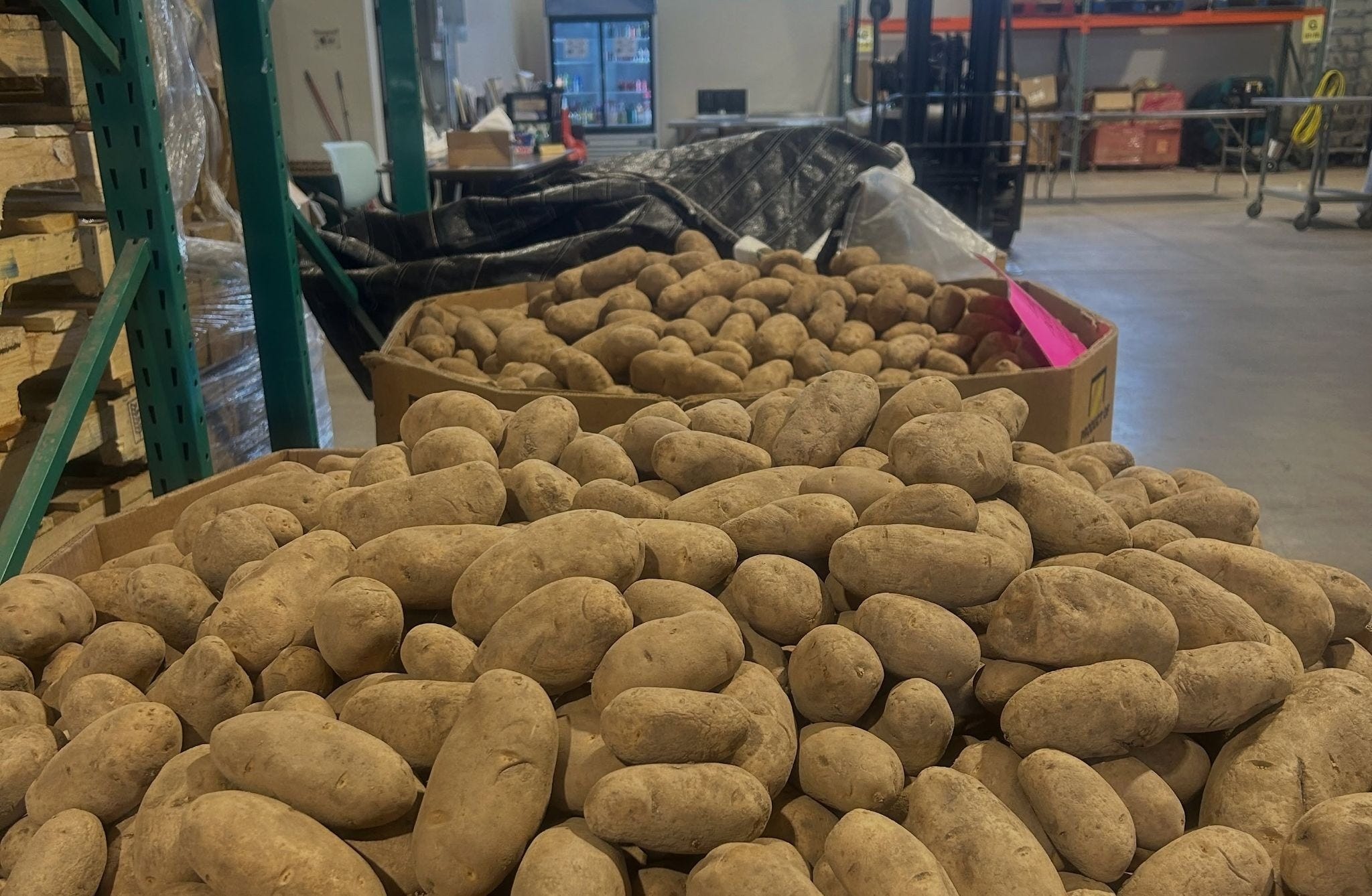
We Don’t Waste saw a spike in interest on social and traditional media recently with its “Potatopalooza” event, where the organization gave away 42,000 pounds of potatoes in roughly an hour and a half.
“We had folks literally backing up pickup trucks and loading up everything in laundry bins,” Hissong said. “It was really incredible to see.”
We Don’t Waste claims to have saved 280 million servings of food since it got started in 2009.
But economic and political shifts can change the shape of food insecurity, which means the organization has to stay adaptable.
Hissong said We Don’t Waste conducts community listening sessions and surveys to better understand the different ways food insecurity affects various communities.
The organization relies heavily on volunteers, and the attention from Potatopalooza is raising awareness about its work. But the main challenge right now is meeting the increasing demand for free and low-cost meals.
“We just need more food,” Hissong said.
NEED TO KNOW
💵 Victor Marx, the Republican in the Colorado governor’s race, is facing allegations of campaign finance violations. Darcy Schoening, a former state Republican party official, filed complaints with the Secretary of State earlier this year claiming over 100 people had collectively given Marx’s campaign tens of thousands of dollars more than allowed under Colorado law. A new complaint by Schoening claims Marx violated campaign finance laws by telling supporters to give unlimited amounts to his bid for the governor’s office by purchasing merchandise from his online store. Further proceedings will determine whether the campaign faces fines or other penalties. (9News / Kyle Clark)
🔫 Coloradans who want to buy semiautomatic firearms with detachable magazines have to take a safety class and a test first, under a law passed last year that went into effect on August 1. Huge numbers of Coloradans requested gun-purchase background checks ahead of the law going into effect, suggesting a surge in demand for the type of weapons covered by the law. (Colorado Newsline / Sara Wilson)
🚱 Rural communities in southern Colorado lack safe drinking water, despite decades-old plans for infrastructure improvements. Some communities in the Lower Arkansas Valley can’t fund the projects themselves, and the Trump administration has held up federal funding. Some local residents have installed expensive filtration systems, while others have to haul water from supply sites. (Rocky Mountain PBS / Priya Shahi)
👶 Colorado’s universal preschool initiative should shrink class sizes, set curriculum standards and bolster teacher training, according to a state-mandated report on the program. Since it launched in 2023, the program has grown to cover about 70% of the state’s 4-year-olds, offering 10 to 30 hours a week of tuition-free preschool. The state is planning to release a five-year strategic plan for universal preschool later this year. (Chalkbeat / Ann Schimke)
📚 Colorado nonprofits are helping students and teachers with the rising cost of back-to-school supplies. Teachers often spend hundreds of dollars out of their own pockets to stock their classrooms, and families also routinely spend hundreds of dollars on things like clothes, supplies and books as inflation continues to push up costs. Click through the following links for details on how to support and participate in these programs. (Denver 7 / Alex Dowd, CBS / Ashley Portillo)
COMING UP
🧑💻 I’ll be joining Dr. Jonathan D. Rosen on his podcast next Friday, August 14, to talk about the Tren de Aragua gang. Before starting The Blanket, I reported extensively on Tren de Aragua in the United States and Latin America. I’ve been featured as an expert by Denver7, CPR, Westword and many other outlets explaining the reality of the gang’s presence in Colorado and region-wide. I’ve still been keeping tabs on Tren de Aragua, particularly in the United States, so I’m excited for the conversation.