



Colorado voters will decide four ballot proposals related to taxes and spending this year that could have big impacts on the state budget, which is struggling to keep pace with rising costs and growing demands for public services.
All of the measures would affect how Colorado collects and spends taxes amid a years-long cycle of budget shortfalls related to TABOR, the Taxpayer’s Bill of Rights, which limits government spending and requires taxpayer refunds when the state collects taxes above the budget cap.
The costs of healthcare and other government programs have grown faster than anticipated in recent years, and reductions in federal funding have shifted more costs onto states. But Colorado’s budget hasn’t been able to accommodate those changes, because TABOR doesn’t allow spending to grow just because program costs go up.
TABOR limits the year-to-year growth of the budget by tying it to the state’s population growth and consumer inflation. So when program costs grow faster than the TABOR limits, lawmakers have to make cuts to stay within the constraints.
The cycle seems due to repeat again in the coming year, with recent projections estimating the state could face a shortfall of well over $1 billion.
What would Proposition NN do?
One of the ballot measures, Proposition NN, would allow the state to keep tax money it would otherwise have to refund under TABOR in order to spend it – at least initially – on education and other programs for kids.
It is the only measure that lawmakers voted to put on this year’s ballot. The campaign in favor is backed mainly by teachers unions and progressive activists.
The measure would create a new state fund for education and other children’s services. For the first 10 years, lawmakers could use the money only for those purposes, and the state and school districts would have to publicly report how the money is spent. After that, state lawmakers would have more discretion over how to spend it.
Supporters describe Proposition NN as a way to raise billions for schools, but there are a few caveats to that claim.
The measure would indeed raise the TABOR cap by billions of dollars, however for at least the next few years, the actual amount of additional money the state would get for education would likely be in the hundreds of millions of dollars. It’s hard to predict accurately beyond that, because it’s unclear how the economy might change and how those changes could impact future tax revenues.
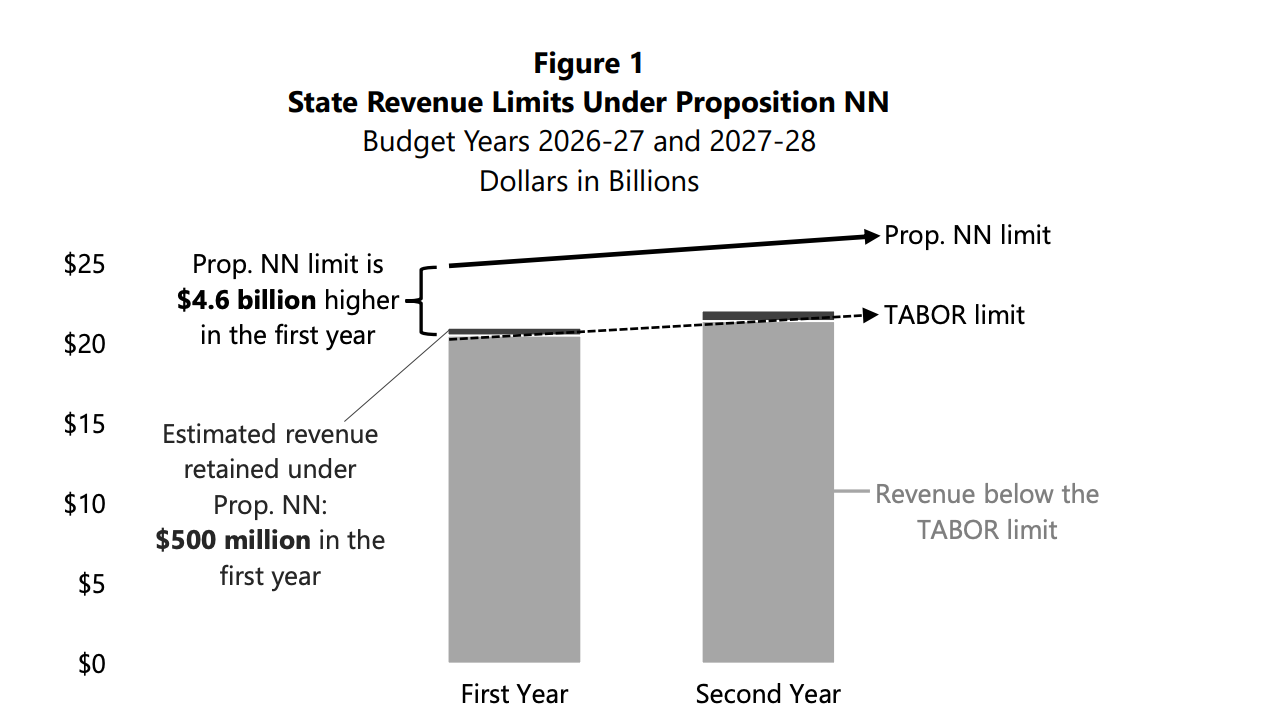
The amount available for schools and kids in the near term could also be smaller if Proposition NN passes alongside Proposition 137, discussed below. The latter measure would direct tax money toward conservation and recreation, and exempt that money from TABOR limits, effectively reducing the amount available for the programs that Proposition NN would fund.
Supporters say the long-term benefits of giving more potential funding to education weigh in favor of passing Proposition NN, even if the initial increases in actual funding are modest.
“We support both, while acknowledging the imperfection of the system, in its current form,” said Joshua Mantell, the director of government affairs at the progressive Bell Policy Center.
Two separate, state-funded studies last year recommended Colorado increase spending by billions of dollars to meet its K-12 education goals. Six in ten Coloradans who responded to a poll last year said schools need more money to see improvements.
Critics of Proposition NN focus on the likelihood that it would reduce or eliminate TABOR refunds that could otherwise send hundreds of dollars a year back to each taxpayer.
Supporters counter that TABOR refunds are generally too small to solve broader affordability problems, and point to the well-established economic benefits of education spending.
What would Proposition 137 do?
The measure mentioned above, Proposition 137, would direct taxes from sports equipment sales and rentals toward conservation, wildfire mitigation and outdoor recreation. It would also make that money exempt from TABOR limits.
Conservation groups are the primary funders of the campaign in support of the measure, though it also has support from outdoor groups and businesses.
The measure would direct an estimated $175 million a year in existing sales tax revenue from sporting goods to conservation, wildfire mitigation, water protection and outdoor recreation. It would not raise the sales tax rate or directly increase prices.
Proposition 137 would also make that sales tax revenue exempt from TABOR. In years when total tax revenues are above the TABOR cap, the measure could reduce or eliminate taxpayer refunds. And, as explained above, it could cut into the additional money available for education under Proposition NN if both measures pass.
In years when the state collects less than the TABOR cap, the conservation money would come out of the state’s general fund. That could leave less for other programs, though the measure does explicitly protect tax credits for low-income households.
Supporters say Colorado needs more money for conservation, watershed protection and wildfire preparation as climate change brings hotter temperatures and increased risks to some of the state’s most valuable economic assets.
Opponents question the science behind wildfire prevention programs that cut down trees to manage fire risks, arguing money should be directed instead toward hardening structures. But supporters of Proposition 137 say it’s not an either-or choice, since some of the additional funding would go to hardening efforts as well.
Opponents also point to the possibility of reduced taxpayer refunds, but supporters say the programs Proposition 137 would support are worth the investment.
“Each is governed and audited by nonpartisan boards or has financial accountability directed by state law and is subject to state audit,” said “yes” campaign spokesperson Curtis Hubbard. “This guarantees the money directly supports vital water, land, and wildfire protection projects as well as efforts to bolster outdoor access.”
What would Amendment 87 do?
A third proposal, Amendment 87, would cut most people’s income taxes while making the highest-earning people and companies pay more. The tax hike on high earners would generate additional money for education, children’s programs and healthcare.
The campaign supporting Amendment 87 is backed by progressive activist networks, some of which support propositions NN and 137 as well.
Amendment 87 would replace Colorado’s flat 4.4% income tax rate with a graduated system that taxes income in bands. Each band would be taxed at a different rate, as shown in the graphic below.
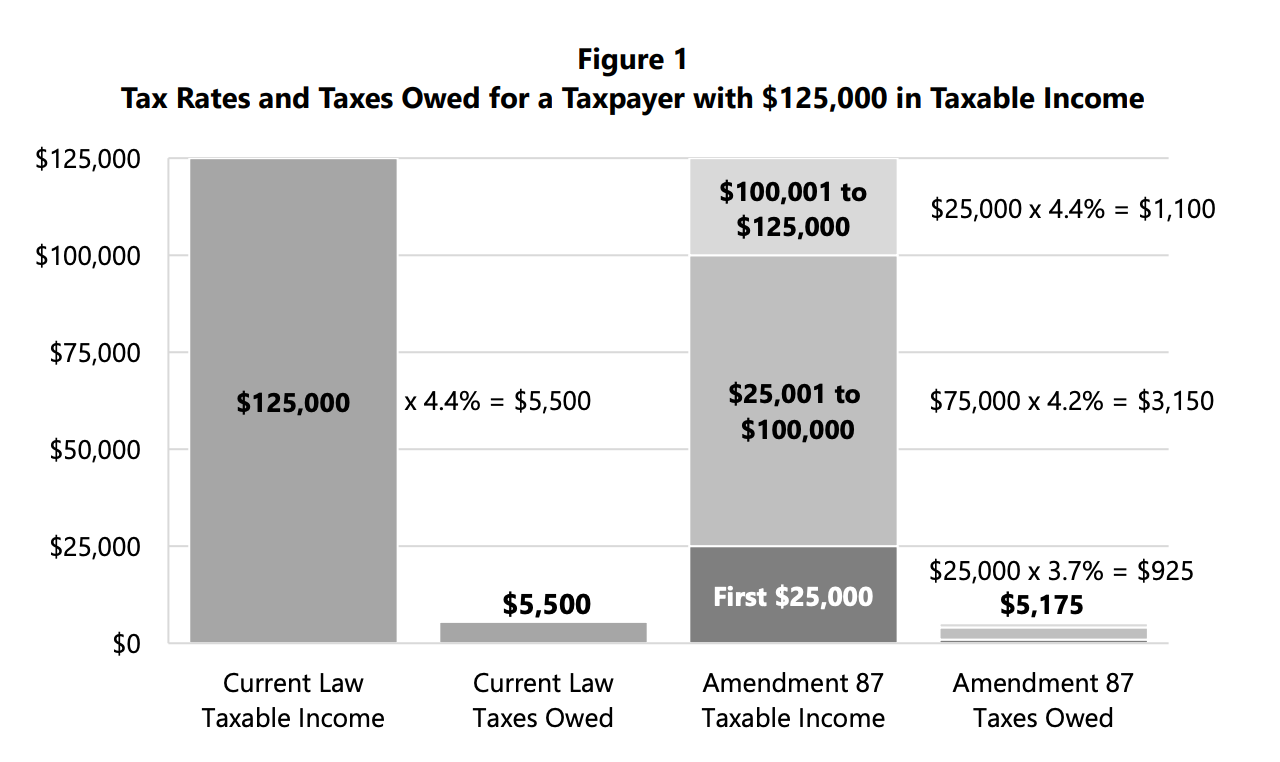
People and businesses making less than $500,000 per year would see their taxes decrease by roughly $200-$300 per year. Income up to $25,000 would be taxed at 3.7%, while income between $25,000 and $100,000 would be taxed at 4.2%. The current 4.4% tax rate would stay in effect for income between $100,000 and $500,000.
Those earning more than half a million dollars per year could see their tax bills go up by thousands or tens of thousands of dollars. Tax rates on incomes between $500,000 to $750,000 would rise to 7.4%, incomes between $750,000 and $1 million would be taxed at 7.9%, and anything over $1 million would be taxed at 8.4%.
The measure is expected to raise about $2.7 billion a year in additional tax revenues. The money would be exempt from TABOR and directed toward K-12 education, healthcare and early childcare and education. And it requires an annual public audit of how the money is spent.
Supporters say the constitutional amendment would make the tax system fairer and help replace funding lost as federal tax and spending changes shift more responsibility onto Colorado. They argue that higher-income households and large corporations can and should contribute more.
Opponents have claimed raising rates on high earners could discourage investment, push wealthy residents and businesses to leave, or reduce job creation. But economic research disputes those claims, and supporters say the tax cuts for lower-income people will keep money in Colorado.
“Lower income people, middle-income people tend to spend all their money in the local economy,” said Chris Stiffler, a senior economist at the progressive Colorado Fiscal Institute. “So a dollar given to them … jump starts the spending multiplier better than say someone who’s taking that dollar and spending on a stock or buying a trip to Paris.”
Opponents of Amendment 87 also argue that the state should reduce waste and administrative spending before being trusted with more taxpayer dollars. Supporters acknowledge those efforts are worthwhile but say the savings would be too small to cover multibillion-dollar shortfalls for essential programs like healthcare and education.
“There’s not like a giant waste, fraud and abuse chunk of our pie,” Stiffler said.
What would Proposition 136 do?
The fourth measure, Proposition 136, wouldn’t actually change anything if it passes on its own, but it’s meant to interfere with Amendment 87 by limiting its impact if both measures pass.
Proposition 136 is backed by conservative activist groups behind several other measures on this year’s ballot.
The goal of the measure is to lock in Colorado’s individual and corporate income tax rates at the current flat rate of 4.4%. That would conflict with the graduated income tax system proposed by Amendment 87 described above.
When two conflicting measures pass in the same election, Colorado law says the one with the most votes in favor should prevail. But that scenario would likely result in a lawsuit or an intervention by state lawmakers to clarify any uncertainty.
* Correction: This version has been updated to remove an inaccurate description of the required share of votes needed for passage of Amendment 87. The measure requires a simply majority to pass.
NEED TO KNOW
🗳️ Voting rights groups plan to send around 1,000 nonpartisan monitors to polling places in Colorado, up from about 300 during the 2024 election. The volunteers will help voters, document ballot access issues, and report potential intimidation amid heightened fears about political interference and immigration enforcement near voting sites. Most Colorado voters mail their ballots; fewer than one in 10 went to the polls in person in the 2024 general election. (Colorado Newsline / Sara Wilson, Secretary of State press release)
🔌 Xcel electricity customers have been experiencing more frequent and longer power outages since 2024, according to a report from the state’s Public Utilities Commission. The regulator is still looking into the reasons behind the uptick. (Colorado Sun / Mark Jaffe)
⛈️ Scientists in Colorado are trying to better understand how to protect hail-prone communities from more destructive storms linked to climate change. (High Country News / Hannah Covington)
🪲 Jefferson County is expanding a program that helps private landowners clear pine beetle-infested trees to limit the spread of the bugs, which are devastating Front Range forests. (CPR News / Amanda Williams)
👥 State lawmakers are looking to cut funding for peer-led addiction counseling programs, which have cost far more than expected and raised questions about their efficacy. (Colorado Sun / Jennifer Brown)
⛓️ People held at the ICE detention center in Aurora say the privately run facility is rife with violence, inadequate medical care and other poor conditions, echoing numerous similar reports from that immigration jail and others across the country stretching back years. (Denver Post / Seth Klamann and Elizabeth Hernandez)
⚖️ The state is suing ICE over its plans to reopen a closed-down prison in Hudson, outside Denver, as Colorado’s second immigration jail. Two other lawsuits by private groups have already targeted the proposed facility, but the state brings additional legal firepower to the fight. I explain more in this video report.
COMING UP
🏀 It’s NBA basketball season and the Nuggets have their first preseason game this weekend. I don’t follow American football (sorry Broncos fans) but I do love hoops. I may use this section of the newsletter to occasionally focus my accountability lens on the on-court performance of the Nuggets players and their coaching staff. If you’re overwhelmingly against hearing my basketball takes, let me know, and I’ll consider sticking to hard news rather than hardwood analysis.