


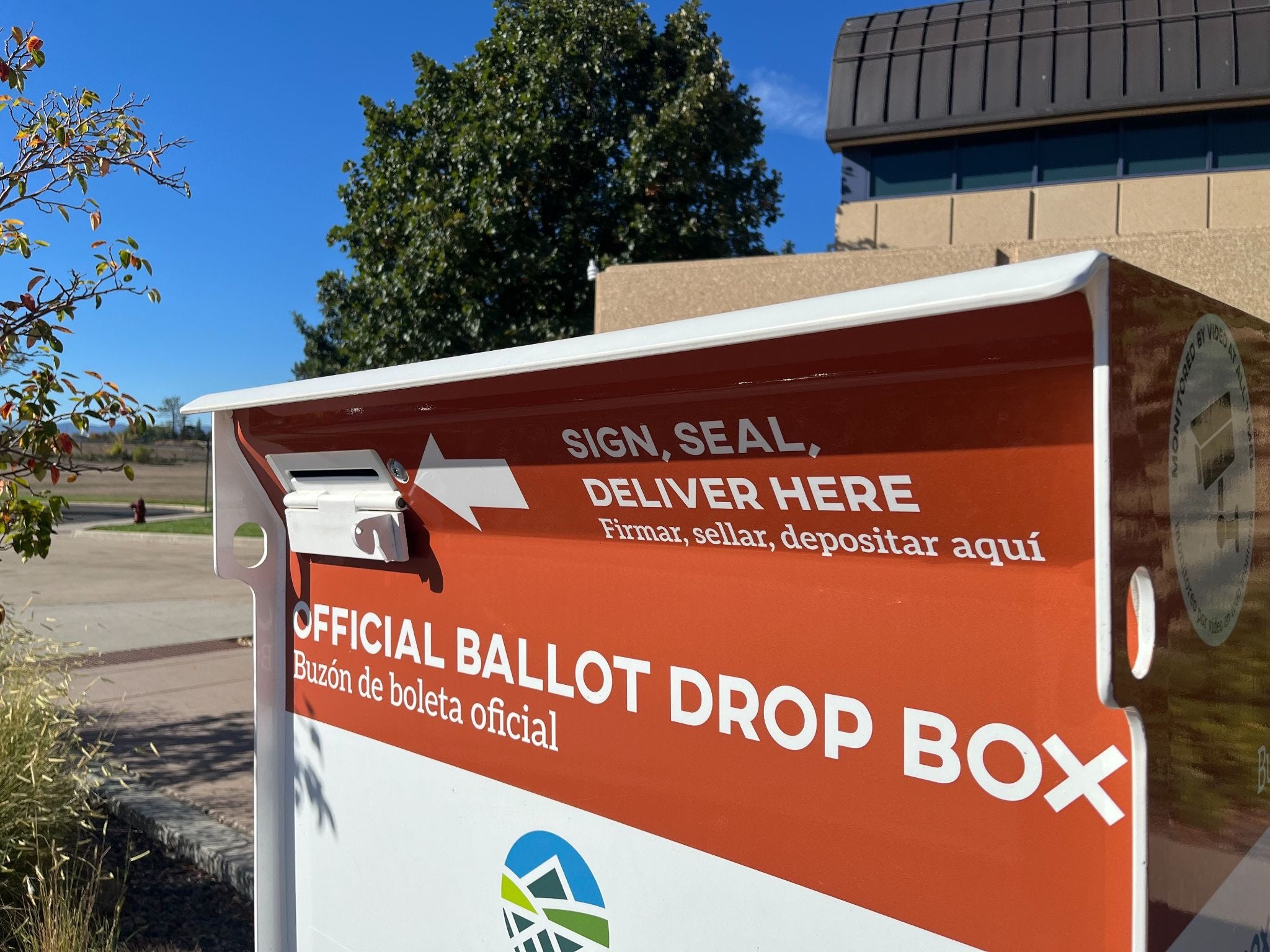
Coloradans will decide on two ballot measures in the coming weeks that could change voter ID rules and how ballot questions are written in future elections.
Both of the measures – Amendment 84 and Amendment 85 – would change the state’s constitution, meaning they would need at least 55% approval to pass.
What would Amendment 84 do?
The measure known as Amendment 84 would require Coloradans who vote by mail to write the last four digits of their social security, driver’s license or other state-issued ID number on the outside of their ballot envelope.
If a voter doesn’t provide an ID number, or if an election judge can’t confirm the number, the voter would be notified and the ballot would not be counted until the person confirms their identity with election officials.
The measure would affect the vast majority of Colorado voters, more than 90% of whom have cast their ballots by mail in recent elections.
Current law requires voters to provide ID when they register to vote as well as the first time they vote by mail, in certain circumstances.
Current law also requires voters to sign their ballot envelopes. Election officials use machines to help them check those signatures against the signatures they already have on file. If there’s a problem, voters are notified and given an opportunity to verify their ballot so it can be counted.
The signature requirement would stay in place alongside the added ID number requirement if Amendment 84 passes.
Most states use signature verification for mail-in voting, but some have added extra ID requirements in recent years like those proposed by Amendment 84. Proposals similar to Amendment 84 are on the ballot this year in California, Arizona and Nevada.
The campaign in favor of Amendment 84 is funded by organizations that obscure the origins of their money. The measure’s registered representatives, Suzanne Taheri and Chuck Broerman, both have been active in Republican politics. They did not respond to requests for comment.
Supporters of increased voter ID requirements argue they improve trust in elections and prevent voter fraud, even though voter fraud is already very rare. Colorado has seen fewer than two dozen people convicted of voter fraud in the past two decades, according to a database compiled by the conservative Heritage Foundation think tank.
Beth Hendrix, the executive director of the League of Women Voters of Colorado, which opposes Amendment 84, called it “a solution looking for a problem.”
Opponents also say the measure poses privacy risks and could lead to ballot access issues for various communities.
“Older voters, voters with disabilities, rural voters – anyone without easy access to transportation or the internet to fix any clerical error – their votes may go uncounted,” Hendrix said.
The measure could cost a few million dollars to implement, with the costs split between counties and the state, according to nonpartisan legislative analysts.
What would Amendment 85 do?
The measure known as Amendment 85 would require ballot questions to be written so an eighth-grader can understand them, and it would ban laws that could interfere with that goal.
Ballot questions are written by officials on the state’s Title Board, which is required by current law to translate the underlying legal language of each proposal into a yes-or-no question accessible to a wide audience.
Despite the existing plain-language requirements, Colorado ballot questions are often notably complicated. CBS Colorado used a well-known readability test on this year’s ballot measures and found that most exceeded an eighth-grade reading level – including Amendment 85 itself, which scored at an 11th-grade level.
Supporters of Amendment 85 say setting the eighth-grade reading-level requirement would give the Title Board a clearer benchmark for determining what counts as plain language. They point out that the average adult in Colorado reads at about an 8th grade level and they argue that the average citizen should be able to understand what they’re voting on.
While readability requirements for ballot measures are common in other states, only a handful including Arkansas, Rhode Island and New York specify an eighth-grade reading level.
Opponents of Amendment 85 emphasize that they don’t oppose accessible ballot language. But they note that Coloradans already have access to easy-to-understand information about ballot initiatives in the form of voter guides produced by political advocates and media organizations, plus the official, nonpartisan descriptions contained in the “blue book.”
Putting the eighth-grade standard in the constitution and barring laws that might interfere with it could lead to more legal fights, opponents say.
“It ties the hands of our elected legislature and will likely increase the need for the courts to decide what certain language means,” said Hendrix of the League of Women Voters of Colorado, which opposes the measure.
Amendment 85 is backed by the conservative activist group Advance Colorado, which is supporting several other measures on this year’s ballot. The group did not respond to requests for comment.
Some centrist and progressive advocates have also gotten behind Amendment 85, though several prominent progressive groups oppose it.
NEED TO KNOW
🫢 A lack of communication among officials led to nearly 800,000 Colorado voters receiving ballots with a question about rail transportation taxes that they are not eligible to vote on. The measure, known as 7A, would raise taxes on communities near a planned rail project to help pay for it. Rail officials changed the boundaries that defined which communities would be asked to vote on the measure but failed to tell county clerks. It’s not yet clear exactly how officials plan to handle the error. (9News / Marshall Zellinger)
🫥 The head of the Colorado Department of Human Services, Michelle Barnes, resigned without explanation this week amid intensifying scrutiny of the agency, which provides services for vulnerable populations like children, older adults, and people with disabilities and mental health challenges. Agency employees have complained about poor leadership, discrimination and retaliation since Barnes took over as executive director in 2019, leading to nearly $3 million in payouts aimed at settling those claims. (Denver Post / Katie Langford)
🤑 Colorado’s Republican candidate for governor, Victor Marx, is appealing a fine of more than $57,000 for over 200 alleged campaign finance violations. An official handling the case called the scale of Marx’s alleged violations “without precedent” and said they were “intentional,” but Marx has denied wrongdoing and claimed the fine was politically motivated. (Colorado Politics / Marianne Goodland, read more about the allegations) Marx’s campaign also has reported some unusual, though not necessarily illegal, expenditures. (CPR / Ben Markus)
🧐 There are a few reasons to question claims by federal prosecutors that international leaders of the Venezuelan gang Tren de Aragua were behind a violent 2024 kidnapping in Denver. Three men were sentenced this week to 20 years in prison after pleading guilty to the crime, but at least two of those men have denied being members of the gang. I explain more in this video report:
FOLLOWING UP
⚕️ I’ve gotten a lot of social media comments on my coverage about trans kids’ healthcare in Colorado, many of which have focused on the medical debate around gender-affirming care. This week, the Colorado Medical Society, the state’s largest doctors’ group, publicly stated its opposition to Proposition 135, which aims to ban gender surgeries for minors. The group acknowledged that doctors have different opinions about gender-affirming care, but it said the proposed ban conflicts with its view that doctors and patients should have the ability to make decisions that are “guided by medical expertise, science and the unique needs of each patient.” (Erin in the Morning / S. Baum)