


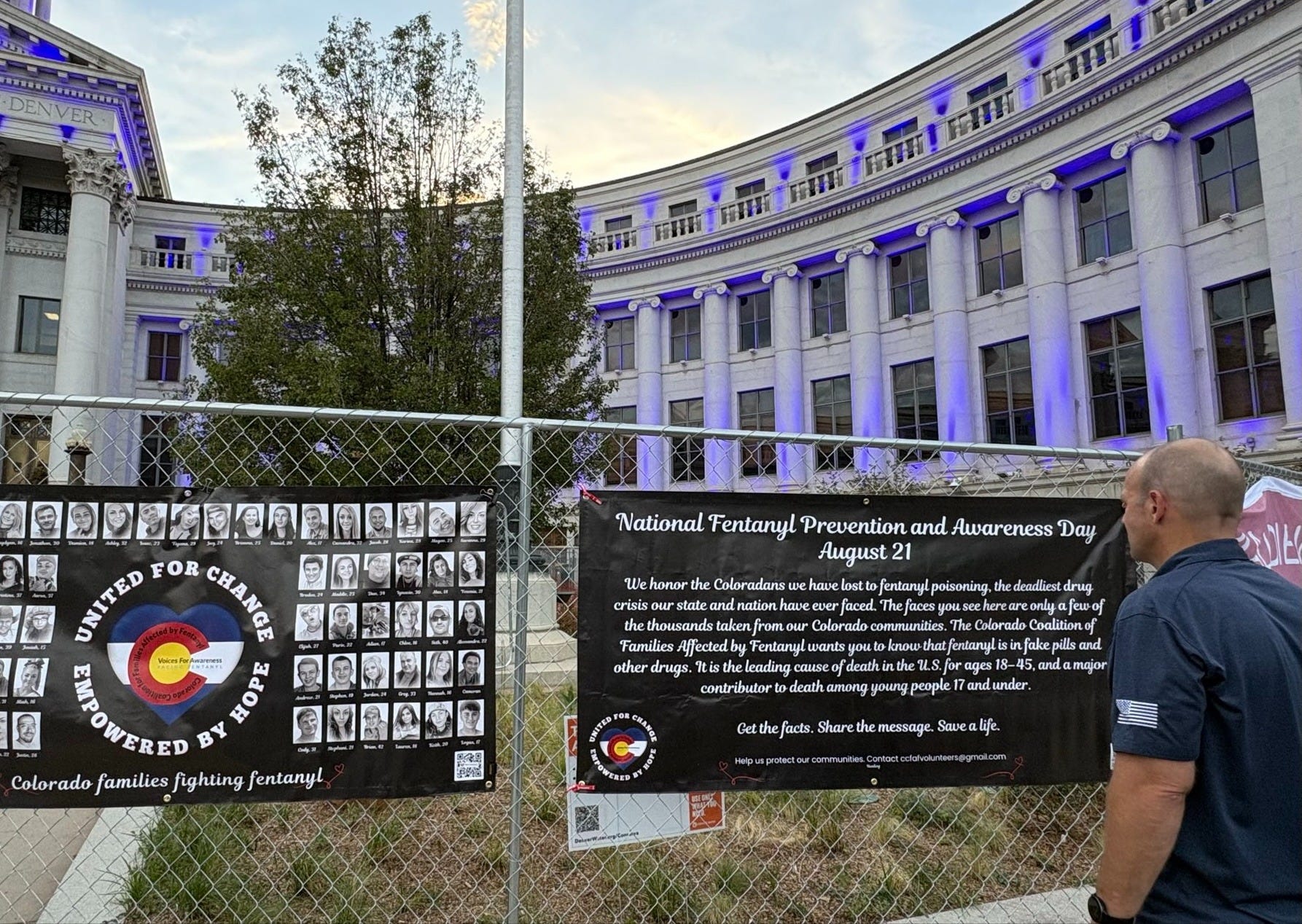
Colorado voters will decide this fall whether to enact stricter penalties for possessing and distributing fentanyl, even though harsher punishments are unlikely to address increasing overdose deaths.
Colorado started seeing an increase in overdose deaths related to fentanyl and other synthetic opioid drugs in late 2024, even as overdose death rates at the national level continued a decline that started in 2023.
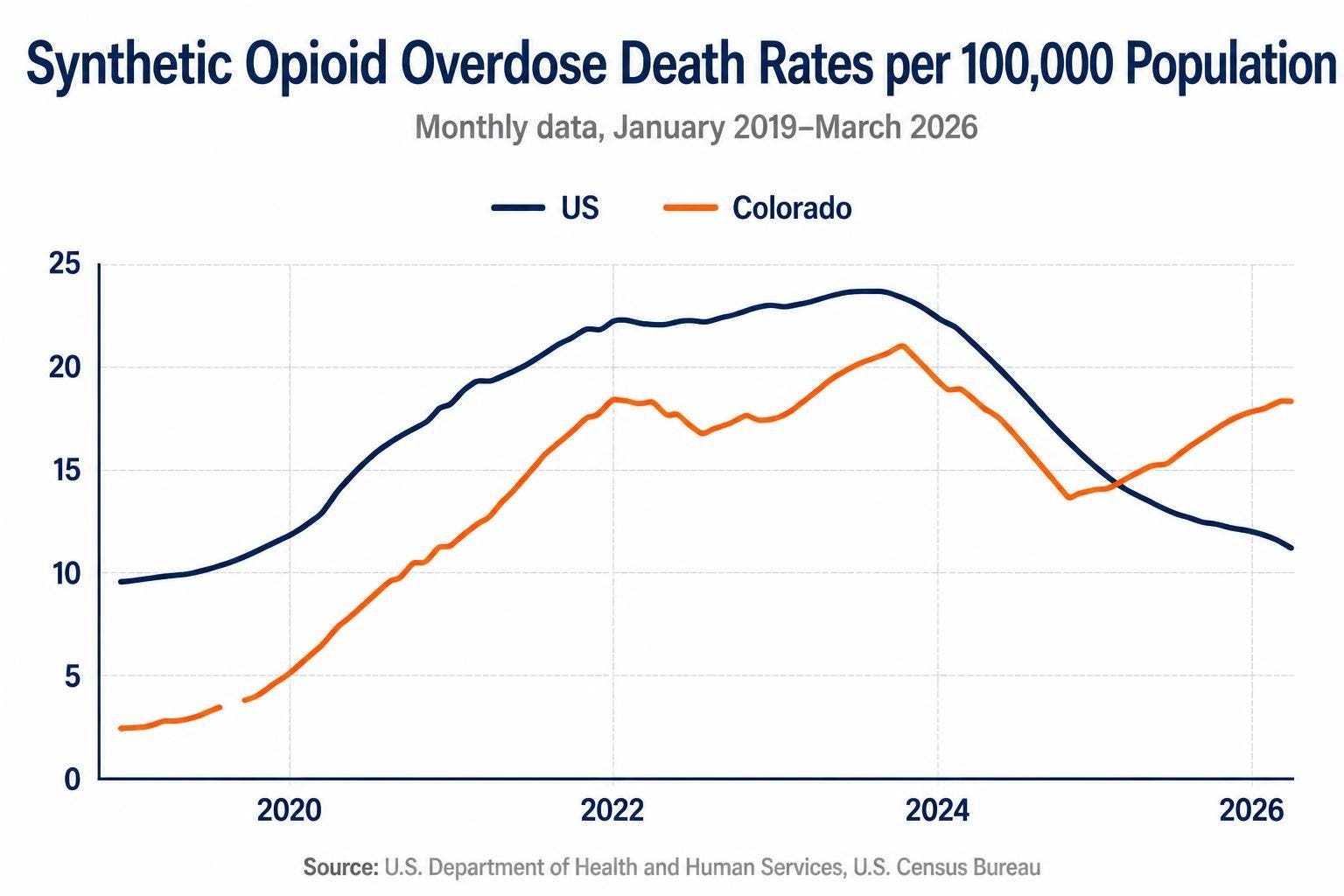
The factors behind the changing overdose rates are complex. The nationwide decline likely stems from a combination of decreased fentanyl production by organized crime, increased seizures by law enforcement, greater drug tolerance among users, and improved access to addiction treatment and overdose-reversing medications.
The reasons why Colorado is defying that national trend are murky. But the data – and the devastating human stories of fentanyl addiction and overdoses – have become talking points for the conservative, billionaire-backed advocacy group Advance Colorado, which is pushing the dubious idea that the stiffer penalties proposed by ballot initiative 85 would deter drug trafficking and drug use.
Advance Colorado did not respond to multiple requests for comment.
What is fentanyl?
Fentanyl was first developed in the mid-20th century as a painkiller, and for decades its use was mostly limited to legitimate medical settings.
In more recent years, however, criminal organizations figured out how to manufacture and traffic the drug illegally to meet a growing demand for opioids in the United States, spurred in part by overprescription of legal painkillers.
Illicitly produced fentanyl was a big driver of a spike in drug overdose deaths in the United States that started in the mid-2010s and continued until 2023.
Not only are synthetic opioids extremely potent, but the quality and purity of underworld drugs can vary greatly from batch to batch, making it difficult for users to administer consistent dosages. Moreover, fentanyl is sometimes mixed into other illegal drugs, so some users may not even be aware that they are consuming it.
The rapid and substantial increase in overdose deaths across the country in the 2010s and early 2020s contributed to the spread of misinformation about fentanyl and spurred many states including Colorado to enact harsher penalties for the drug. At the end of 2025, the Trump administration labeled illicit fentanyl a “weapon of mass destruction.”
What would the ballot measure do?
Ballot initiative 85 would increase the penalties for people who possess and distribute smaller amounts of fentanyl and other synthetic opioids, without increasing penalties for the most prolific traffickers.
Under current law, possession of less than a gram of fentanyl and other synthetic opioids is a misdemeanor and criminal charges for distribution get more severe for distributing larger amounts of the drug.
If voters pass initiative 85, it would change the current law and make it a felony to possess any amount of fentanyl. That could include drug users who aren’t even aware of fentanyl mixed into other drugs.
Initiative 85 would also apply the harshest trafficking charges available for the distribution of any amount of fentanyl. That would mean that someone who shared a single dose of fentanyl with a friend would face the same potential prison sentence of 8 to 32 years as a trafficker moving large amounts of the drug.
The measure does not provide any additional funding for prevention or treatment of fentanyl addiction and overdoses, though it does mandate treatment for people who are convicted on drug charges.
What could be the consequences?
The measure, if passed, likely would not reduce overdose death rates in Colorado.
A state-commissioned report published in 2024 found that a 2022 law that increased penalties for fentanyl possession in Colorado “did not change” drug overdose death rates. Moreover, those harsher penalties have failed to prevent the increase in overdoses observed since the study was published.
Some experts warn that ratcheting up penalties even more could cause overdose deaths to increase further, in part because users will be more afraid to reach out for help.
The measure could also cost Colorado millions of dollars per year, according to nonpartisan analysts who work for the state legislature.
The increased penalties for fentanyl possession and distribution would send hundreds more Coloradans to prison each year, the analysts estimate. Not only would that further stress a system that is already near capacity, it would also redirect more resources toward incarceration that could otherwise be used for programs to prevent and treat problematic drug use.
Many experts have argued for years that drug addiction and overdoses should be treated as a public health problem rather than as a criminal issue.
“If the war on drugs worked in the 80s and 90s, there wouldn’t be a drug problem,” said Kyle Giddings, the deputy director of the Colorado Criminal Justice Reform Coalition. “We have learned from history that increasing penalties just doesn’t work.”
Watch the full interview with Giddings 👇

NEED TO KNOW
💧 Colorado will not face mandatory water restrictions under a new, short-term federal water management plan for the Colorado River. The federal government’s two-year plan released last week spared Colorado and the other “upper basin” states of Wyoming, Utah and New Mexico — where most of the river’s water originates — while imposing cuts on the “lower basin” states of Arizona, Nevada and California that use more water. The two groups of states have struggled to reach an agreement on how to manage the river, which some measurements show is at record lows after a historically hot and dry winter. (Colorado Sun / Shannon Mullane, Colorado Newsline / Chase Woodruff)
📚 Colorado’s most controversial education cooperative is dissolving after 13 years. Education reEnvisioned Board of Cooperative Educational Services, or ERBOCES, attracted scrutiny recently over its involvement in the launch of a “public Christian school” aimed at testing laws against public funding for religious education as well as its creation of dozens of homeschool enrichment programs that used public money to pay for a wide variety of activities including ski trips and sports camps. ERBOCES was one of 21 co-ops formed by school districts statewide to offer educational programs that a single district might not be able to provide. The co-ops need at least two members, and one of ERBOCES’ last two members voted last week to disband it. (Chalkbeat / Ann Schmike)
🏫 Colorado students showed improvements in math scores and mixed results in literacy on statewide standardized tests called the Colorado Measures of Academic Progress, or CMAS. Newly released data for 2026 showed math scores rose for elementary and middle school students, while fourth and fifth graders’ reading and writing scores increased and middle schoolers’ declined. The data also showed big racial disparities in the scores. The scores come with several caveats, including the fact that parents can opt out, so not all students take the tests. (Chalkbeat / Melanie Asmar, Colorado Sun / Erica Breunlin)
📱 Colorado will get about $615 million from a legal settlement with Facebook and Instagram’s parent company Meta over mental health harms allegedly caused by social media. The payout comes as part of a broader, $18 billion settlement with 47 states that had sued the company. The money will be used for programs to support youth mental health. As part of the deal, Facebook and Instagram will roll out new features designed to limit when and how long kids can use the apps, in addition to stronger filtering of potentially harmful content. (Denver Post / Meg Wingerter)
COMING UP
🏊🚴🏃 I’ve been busy this week getting ready for the Local News Solutions conference in the Denver area (in addition to preparing to compete in the Boulder Sunset triathlon this weekend). Ahead of the conference, I published a video asking for ideas about how to improve local news in Colorado, and I got some great responses. I think conversations about the future of journalism would benefit from more input from audiences, so I’m always open to comments, questions and criticism. Send me a message anytime. I’ll report back next week about what I learn at the conference.